Coffee
The Misconception: Coffee stimulates you.
The Truth: You become addicted to caffeine quickly, and soon you are drinking coffee to cure withdrawal more than for stimulation.
Mmmm, a warm cup of coffee with delicious cream, topped with a frothy head.
You smell it brewing and feel cozy inside as you browse cakes and brownies, scones and biscotti.
You get some of it in you, and you feel alive again – you feel superhuman.
Suddenly, you feel like John Nash, you can’t keep up with your own mind as geometric symbols float over the magazine articles in your lap. Someone strikes up a conversation about health care, and suddenly everything you’ve ever heard about the topic is at the tip of your tongue.
Damn, coffee is awesome.
Except, of course, much of this is an illusion.
The truth is, once you’ve been drinking coffee for a while, the feeling you are getting after a cup isn’t the difference between the normal you and the super you, it’s the difference between the addict before and after a fix.
Ok, this is a very simplified explanation:
Caffeine is an adenosine antagonist. This means it prevents adenosine from doing its job.
Your brain is filled with keys which fit specific keyholes. Adenosine is one of those keys, but caffeine can fit in the same keyhole.
When caffeine gets in there, it keeps adenosine from getting in.
Adenosine does a lot of stuff all throughout your body, but the most noticeable job it has is to suppress your nervous system. With caffeine stuck in the keyhole, adenosine can’t calm you down. It can’t make you drowsy. It can’t get you to shut up.
That crazy wired feeling you get when you drink a lot of coffee is what it feels like when your brain can’t turn itself off.
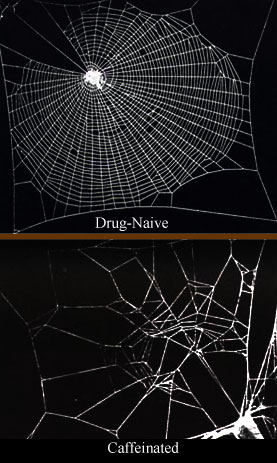
To compensate, your brain creates a ton of new receptor sites. The plan is to have more keyholes than false keys.
The result is you become very sensitive to adenosine, and without coffee you get overwhelmed by its effects.
After eight hours of sleep, you wake up with a head swimming with adenosine. You feel like shit until you get that black gold in you to clean out those receptor sites.
That perk you feel isn’t adding anything substantial to you – it’s bringing you back to just above zero.
In addition, coffee stimulates your adrenal glands, which makes you feel like you could take a bullet and eat glass. When the adrenaline runs dry, you feel like you’ve been running a marathon, which leads you to look for more coffee to get those glands pumping again.
After a few rides on the adrenal roller-coaster, you crash.
You might think all of this probably takes a while, but it takes about seven days to become addicted to caffeine.
Once addicted, you need more and more coffee to get buzzed as your brain gets covered in receptor sites. Neurologists report seeing patients regularly who drink two or three pots of coffee in one sitting before starting their day.
Coffee also releases dopamine, the feel-good chemical in the brain which is released when you have an orgasm, win the lottery and shoot heroin. A similar addiction cycle with dopamine leads to depression and fatigue when you aren’t hitting the beans.
Finally, caffeine takes about six hours to leave your system. So if you drink coffee six hours or less before going to bed, you won’t reach deep sleep as often. This means you wake up less rested, and need more coffee.
If you’ve been drinking coffee for a while, you aren’t getting nearly as much out of it as you did in the beginning. You are just curing an addiction.
“The take home is that regular use of caffeine produces no benefit to alertness, energy, or function. Regular caffeine users are simply staving off caffeine withdrawal with every dose – using caffeine just to return them to their baseline. This makes caffeine a net negative for alertness, or neutral at best if use is regular enough to avoid any withdrawal.”
- Neurologist Stephen Novella from his blog, Neurologica
Mind you, this is not a dependency. You will experience withdrawal symptoms upon cessation, but not like with amphetamines and cocaine.
Coffee doesn’t seem to affect the dopaminergic structures related to reward, but before you breathe a sigh of relief, ask yourself how long you’ve been drinking it. Try and stop for two weeks and see how hard it is.
A cup or three will still give you pep, but as with all stimulants, over time you need more and more to reach that golden hum.
Don’t freak out, 90 percent of Americans are just like you, and you are not so smart.
You Are Not So Smart – The Book
If you buy one book this year…well, I suppose you should get something you’ve had your eye on for a while. But, if you buy two or more books this year, might I recommend one of them be a celebration of self delusion? Give the gift of humility (to yourself or someone else you love). Watch the trailer.
Order now: Amazon - Barnes and Noble - iTunes - Books A Million
Links:
Drinking coffee doesn’t make you more alert, new study shows
The effects of chronic caffeine intake on adenosine receptors
Caffeine and adenosine receptors, a genetic view
Caffeine Withdrawal A Recognized Disorder
Adenosine and caffeine at About.com
Tolerance and addiction to coffee at Wikipedia
Trackbacks
- 2:30 post on a worknight « marcpieno.com
- Morning Take-Out - DealBook Blog - NYTimes.com
- Does caffeine work?
- Mornings « Contemporary Contemplations
- Why performing Religious Activities is like drinking Coffee…. « Rectilinear Redemption
- Shaolin Porteño » Blog Archive » El camino del té
- Is there value in drinking coffee? « Thoughts of a Cynical Investor
- Contest Entry #2 « You Are Not So Smart
- Coffee Addiction | andante favori
- Coffee | late last night
- Experiment, Adopt, Achieve » Sleephacking
- Coffee « IDeological Musings
- Grab a Hypodermic, I Need Some Coffee! | Health to the Know


I love coffee – I don’t care what it does.
SPN Headlines got the scoop on this story – Doctors Will “Tweet” Patients:
http://stupidassnews.wordpress.com/2010/02/21/final-health-care-bill-doctors-will-tweet-patients/
Have a great day! :-)
damnit. i am not so smart indeed. :(
Full disclosure – I drink at least three cups a day.
So how long does one need to be off caffeine for your brain to get back to “normal” or do the number of adenosine receptors stay permanently in excess?
The studies I looked at when writing this said just a few weeks.
I recently quit coffee for several months. The headaches were the most severe withdrawal symptom and they lasted about 3 days. I was sluggish and perhaps a little depressed for about 5-7.
After 14 day’s the neurochemistry of your brain has mostly recovered from almost anything except severe benzodiazepine addiction.
So to answer your question. It takes about 2 weeks for your brain to be all the way back to normal.
Today I enjoy a cup of coffee here and there and it is like liquid cocaine again….to the point of after a cup I crave more. I’m amazed at just how addicting it really is….but it sure isn’t anything like Meth.
Could you please define “normal”?
This is idiotic.
Increase in tolerance for a drug does not mean that the primary effect of the drug goes away.
A little knowledge is a dangerous thing.
I am not suggesting the primary effect goes away, but is greatly diminished, as with any addictive substance. Thus, you must keep upping your dose. Most people stop their dose right at the edge of normalcy when it comes to coffee.
This article was written based on a conversation I had with a neurologist who doesn’t drink coffee for all the above reasons.
I’m sure you aren’t disputing the idea that drug tolerance is a real and measurable phenomenon. As I said in the article, some people end up drinking two pots of coffee in the morning to get the same effect as some people get with one cup.
I would define “addiction” as follows: Produces a physical or psychological dependence with harmful effects eclipsing helpful ones, perhaps leading to drug-seeking, physical and mental deterioration, illegal activity, etc. Depending on the individual, caffeine dependence “may” be called an addiction, but hardly always. I think it has a lot to do with individual neurochemistry.
You know, all addictive substances have positive effects to the user.
If something fits the definition of being addicting, then it is.
I would agree except not go so far as to say “idiotic.” Drugs often have multiple effects and you can build “tolerance” to some without others. What exactly that means depends on what you mean by “tolerance.” Do you mean “stop working”? Do you mean the cessation of side-effects? A compounding confusion that even physicians often don’t get is the distinction between tolerance and dependence, and the distinction between physical and mental dependence — and above and beyond all this, the distinction between “dependence” and “addiction.” You can use a drug, be physically and psychologically dependent on it, and yet still have it be helpful. I’m thinking in particular of the minor tranquilizer benzodiazepines, which med practitioner have more or less designated Satan-spawn, yet are some of the most useful drugs ever developed.
It’s ‘a little learning is a dangerous thing.’ Indeed.
Actually the author is right.
I was a heavy coffee drinker…ok I was moderate coffee drinker. The more I drank the more jittery I got, but the less real stimulation I got. I know this because I quit for several months and I now enjoy a cup on occasion. When I drink a full cup now it’s is literally like liquid cocaine. The stimuation and euphoria is quite enjoyable…to the point that I actual start craving more…like cocaine.
So yeah you still get a lift form your morning coffee, but if you quit for awhile and then have a cup you will realize that coffee is actually a damn powerful stimulant…that your brain has adjusted to.
..and no you can’t just keep taking more. Coffee isn’t like amphetamine. It has other side effects like tachycardia and shakes. Actual caffeine is way more toxix than methamphetamine….try snorting a gram of caffeine and see were it gets ya!
Buahahahaha. What I really love about your comment is that you begin it with “This is idiotic.” and end it with a misquoted cliche. Full disclosure: I didn’t drink coffee at all for some of these reasons and now I don’t drink coffee for all of these reasons.
I still get a stimulant effect from coffee even after drinking it for nearly 40 years. I drink 3-4 cups daily and I do notice myself dragging if I don’t drink it for a day or two.
Perhaps I’m deluding myself but I drink it because I love it not because I need the buzz.
Interesting post with lots of “facts” but short on documentation and authority.
You are getting the stimulating effect AND you are curing symptoms of withdrawal.
I’ve gone through and attempted to clear up some of my wording in the article to better reflect that assertion.
Also, I added more links to help people interested in doing their own research.
Thanks for reading.
I know you can build a tolerance to alcohol, but when a hardcore alcoholic drinks a six pack, he is fucked up. Similarly, heroin addicts who have built up a tolerance for the drug manage to OD. These substances still have an effect. I think caffeine is similar.
I’m not sure what you mean by ‘fucked up,’ but if you mean wasted, you’re wrong. I’ve seen my dad kill an 18 pack and walk around just fine back when I was a kid.
My dad could drink a bottle of scotch and walk around just fine. Sure, his speech was slurred, but he could still function. A six-pack was nothing to him.
David McCraney, you need to do an article on the power and uselessness of arguments from experience.
I hate to say it, but everyone here is missing the point.
Caffeine is a drug. The most common association most individuals make with the word ‘drug’ pertains to the cannabis plant, which in itself has numerous industrial benefits.
Wait, where the hell are you going with this, Johnathan?
I’ll put it like this: There are no drugs in the world that don’t have some form of positive effect. There are good and bad effects from drugs, however, that everyone should know before they partake of them. Coffee is included as a drug.
There have been studies (by actual professionals) indicating there are numerous perks about coffee (including anti-oxidants) that greatly outweigh the negative effects (especially in women). The main point to be made is one from both sides of the argument.
I advise that everyone consume coffee (1-4 cups per day max) to gain the positive effects, but only in moderation (no more than 4 cups), as too much coffee is known to cause heart problems. I also suggest that more research about the good and bad of coffee be taken on by the readers of this article so they may make their own unbiased decisions.
Sources: Huffington Post, Harvard [medical school] Health Publications, WebMD, CNN Health.
Trust me, I did my research if anyone wants to check it and see for themselves. You can’t give coffee a bad rap if you don’t know both sides of the story. I hope this helps others with their arguments.
Interestingly, quite a few studies done on caffeine supplementation and exercise indicate that there is a real performance-enhancement effect that occurs with caffeine intake compared to placebo. Whether the effects are an illusion or not, caffeine is having a real effect on both cognitive task performance and physical performance.
This came out today: http://www.guardian.co.uk/science/2010/jun/02/drinking-coffee-alert-caffeine
I have to wonder if they’re relying on “alertness” solely based on the mood profile, because even a quick Pubmed search (string “caffeine performance”) turned up a number of studies in humans and animals that indicated real improvements in cognitive tasks and physical performances.
Then again the number of confounds involved in analyzing all that data is beyond what I’m prepared to deal with on a rainy Sunday, so I’ll just leave it there.
So, how much coffee a day are we talking about (to get you addicted)? Do some coffee brands get you addicted more quickly than others? I’m quite serious with these questions, I’m curious because I can’t relate to this – I used to drink coffee every day with a friend of mine while we were studying for exams – we’d have coffee at noon, or at 5-6pm (I rarely ever have two cups, since the second one sometimes makes me jittery, and I’ve never drunk three in one day). When I started working, I practically stopped drinking coffee for a while, and now I drink it when I find the time (it’s a bit of a ritual – that I can relate to! :))), when I go out with friends, etc. Mind you, I almost exclusively drink coffee with milk (with no more than a few teaspoons of water). I drink Jacobs, but I suppose it doesn’t matter, as long as it has caffeine in it, right? Oh, and I NEVER drink it first thing in the morning, or in the morning at all, for that matter…
I am no expert, you’ll have to look through the links I provided and then branch out with your own research. I presume you need to drink two or three cups a day for seven days, based on what I’ve read, but that’s just a guess.
One of the delights of coffee, for me, is the memories associated with it. I remember as a small child the first thing that met my senses, each and every morning, was the smell of coffee brewing. Even though I didn’t drink it myself back then, I LOVED the aroma that permeated the house. Now I have a coffeemaker that automatically begins its brewing cycle at 5 AM (or whatever time I’ve programmed it for) so that I can STILL be met by that same aroma each morning. It recalls my childhood, that feeling of comfort and safety that most of us felt as young children. There are times when mornings are hectic and I don’t have the time to sit and linger over that first cup, but knowing it’s there if I want it is still important to me. Am I ‘addicted’ to it? I don’t know, but I do know there are days that I get no more than a sip, and I don’t notice any ‘withdrawal’ symptoms. I admit to loving it though. Of course, I’m far from a ‘purist’. I love all the coffeehouse flavours too. Oh, and I can also have a cup directly before bed and still sleep the night through. I do believe that some of us are not highly affected by caffeine, and I have read research that seems to bear this theory out. But, I DO know I will never give it up entirely. It simply tastes too wonderful to me to do so. I could go on about the pleasure of the warm cup heating my hands, etc., but I’m sure you ‘get the picture’ so to speak. (I’m glad you admitted to the vice as well.)
I get the whole sermon on the coffee…what I don’t get is the repetitive use of ‘you are not so smart’ in the post. It really makes you come off as a douche. We all get that it’s your website name.
Thanks, for this post. Having nasty asthma it was nice to read a few followup articles. I always knew that having a cup of joe relieved symptoms, but didn’t know what metabolic pathway was being changed.
http://www.anaesthetist.com/icu/manage/drugs/adenosine/Findex.htm#index.htm
It is a nasty balancing act staying at baseline. You either take steroids or block receptors (caffeine/adenosine, loratadine/histamine, singulair/leukotriene)… Wish I had time to study the metabolic network.
Coffee is still well worth consuming, even if it doesn’t afford any significant cognitive benefits:
>> Exercise physiologists have studied caffeine’s effects in nearly every iteration: Does it help sprinters? Marathon runners? Cyclists? Rowers? Swimmers? Athletes whose sports involve stopping and starting like tennis players? The answers are yes and yes and yes and yes. <> [W]e followed about 50,000 men from 1986 through 2006. And every four years, we asked them how much coffee they drink, both regular and decaffeinated. And we found that men who drank the most coffee, more than six cups – or six or more cups per day, had a much lower risk of lethal or advanced prostate cancer. Their risk was about 60 percent lower than men who didn’t drink any coffee. <<
http://www.npr.org/templates/story/story.php?storyId=121343438
Here’s the link to the article on the athletic benefits of caffeine/coffee:
http://www.nytimes.com/2009/03/26/health/nutrition/26best.html?_r=2&partner=rss&emc=rss
i like the comments by people trying to rationalize their ‘socially acceptable’ addiction. wake up and smell the coffee kooks!
@Charles Broadway
As a former alcoholic I can assure you that when an alcoholic drinks a 6-pack, he’ll only get slightly “higher” than “normal”. Whereas if someone who rarely drinks goes out and drinks 6 beers he’d be quite drunk and behave differently to normal; something an alcoholic wouldn’t do after 6 beers.
Amazing the number of people willing to argue incessantly about coffee because they don’t like the term addicted. Whether or not you like, caffeine is an addictive substance. That’s it. Case closed, etc. etc. There are no two ways about it, though how you use coffee can be the indicator on whether or not its a problem for you. The majority of us don’t seem to have any issue with it, but to deny its addictive potential is like saying cigarettes/heroin/meth aren’t addictive.
@ JFablio
I saw an 800 pound man on tv, you have no right to argue about the addictive potential of butter
You can read about caffeine withdrawal here:
http://symptomsofcaffeinewithdrawal.com/
I do not recommend anyone to start adventure with this drink.
KpuIB5 http://fgb7s3Ffjsev7yrbvqqcf7.com
Good article.Caffeine is one of the three most widely used mood -affecting drugs in the world.It is also potent and quick-acting drug which produces an effect similar to the stress response in our bodies.
Heroin agonizes opioid receptors, dopamine would only get released for psychological reasons. If you injected heroin into an unsuspecting individual, and told him, that it was only saline, and had no effect, there would be no dopamine released.
Yeah I was put off by that too. Heroin doesn’t affect the dopaminergic system at all.
Thanks alot.it’s really agood subject.for me i do not drink alot
I appreciate the information!
I love coffee and drink maybe 2 or 3 cups a day, sometimes more. I was coffee trained as a child. In the mornings my pop would pour me a cup, and we would enjoy our addiction. We never thought about it being bad for us. LOL.
I honestly haven’t noticed much difference if I do not drink my morning coffee but I drink decaf at night and I think I sleep better. Most of the time, I notice it does not make me more aware or excitable when I drink it. When I worked as a security guard at third shift, I tried to use it so I wouldn’t drag all night, but I still did. I suppose I would have to drink a lot for it to work.
My grandfather drank pots and pots every day. I know that if you drink too much, it can poison you but he had gotten quite used to it and built up the ability to drink over the limit of what they say poisons you. I think it is over 40 cups if I remember. He had coffee drinking contests with another person and won, or so my mom tells me. He was also a nervous wreck all the time!
I recall a consumer/lifestyle watchdog show from the 1970′s called “Live It Up”. They concocted a valid little experiment (endorsed by a university chemistry professor) measuring coffee drinking. A series of simple arithmetic puzzles and some hand-eye coordination speed trials with blocks.
The results showed definitively that one cup of coffee improved results across the board, over placebo and non-drinker.
HOWEVER, they took it on step further and tried it with two cups of coffee. The performance measures dropped like a rock to equal or lower than the non-drinker levels.
Moderation in all things, my friends, moderation.
psychologically it helps. Never measured the effect
Caffeine does not induce the production of dopamine; in fact, caffeine first substitutes dopamine then inhibits its production because the former resembles the latter in that they are both 2-phenyl ethylamines. The body is thrifty, so once it gets a compound (or something that it resembles) it needs from an outside source it suppresses the production of the said compound.
We get addicted to caffeine not because we get inundated by dopamine every time we have a “fix”, but because our dopamine production drastically decreases and our body becomes dependent on caffeine as a substitute for dopamine.
“I still get effects from coffee. I notice I don’t feel nearly as awake and alert when I miss my morning cup”
If you relate to that, you still are probably dependent on caffeine if you are a daily drinker.
Caffeine still has an affect. Tolerance plays a huge role in it. I can’t drink more than a double shot espresso, or a large coffee (about 150mg of caffeine) before I start to get the unpleasant side effects. However, I know people who need three cups before they feel anything. Body weight, metabolism, and tolerance are all important factors.
The LD50 of caffeine is about 3-4g which means 50% of the average person with little to no tolerance will overdose on 3-4g of caffeine. Symptoms of overdosing include tachycardia and psychosis. Most die by cardiac arrest.
Symptoms of withdrawal include fatigue, headaches, irritability (don’t talk to me before my coffee), and cravings. The more you drink, the more severe they are. Usually it will subside in 1-4 days.
I’m not against the use of caffeine, don’t get me wrong. I really enjoy the buzz. I’m just fully aware it is a drug and treat it as such. I’m always surprised when people have their first experience with drinking too much, and they seem surprised at the effect it can have. It’s a drug that the majority of people can use and be functional, but it’s an addictive drug nonetheless. I used for a while and I was strict on not exceeding a cup a day, and only drinking 5 days a week. I still had withdrawal symptoms when I kicked the habit for about 3 days. I’ve been off for about a month and I feel better than I did while I uses coffee. I have more energy than before. I have less brain foggy days. I don’t have a desire to get back on caffeine because the improvement has been so drastic. Someday I’ll enjoy the occasional coffee, but not yet.
what if you don’t drink everyday? what if you only have coffee once a week? does it have the same effect?
I thought the chemical released during orgasm was oxytocin?
Thank God, I don’t drink coffee.
I used to drink Pepsi every day, about 6 cans / day when I was younger. I’d also have a coffee or 2 per day. More on weekends. In 2006 I switched to only drinking water, and I did suffer the symptoms above (no energy, headaches, etc). After about 2 weeks, I felt I had a lot more energy all the time, and it was consistant!
The strange thing is, I picked up coffee again 2 weeks ago, but not out of craving. I made a conscious choice to pick it up because I just got Gout, and have to give up many of my favorite things as part of a diet change. Since coffee isn’t on the list, I figured I’d pick it up to compensate :)
I recently did some “research” into this (read: looked at wikipedia) and came to the conclusion that for me the only negative side-effect of caffeine addition is tolerance. So every month or two, I take a couple weeks off of all caffeine sources to cleanse the system.
If you can make it through those two weeks, it makes the re-addiction process all the more enjoyable.
This blog is so fascinating. Thank god I barely ever drink coffee.
Ridiculous. I don’t drink coffee, but I find this article uninformed and probably written by a Mormon, who is against the beverage for religious rather than health reasons. The term ‘drug’ itself is misused a lot. There are many drugs. Drugs that you take to alter your body chemistry. There are many reasons someone would take drugs to alter their chemistry. Take for example, insulin. Caffeine is probably the most stupid ‘drug’ to write an article warning that it could be addictive about…give me a break. “OH Noes! I’m addicted to COFFEE!”
If one wanted to attack a harmful beverage, sugar sodas are a much better target. Not only do they contain this dreadful ‘caffeine drug’ that seems to invoke so much fear, but are also chock full of mouth rotting sugar and calories and have absolutely no nutritional or beneficial effects at all.
There are also studies that indicate that a cup of coffee (caffeinated or decaf) is beneficial for men, helping to reduce the chance of prostate cancer. Another caffeinated beverage that is beneficial to health is tea, green, black, oolong etc. (all come from the same plant), which has caffeine, but is also very healthy.
The world is not black and white. The likelihood of coffee negatively effecting one’s life from drinking one – two cups a day is so extremely low that it really does not warrant much thought. Time could be more productively used writing about more pressing issues.
t’uh.
If caffeine has an effect on my physiology, I haven’t been able to detect it. Very rarely ever have (or am interested in) one cup of cold drip in the morning. Nice little ritual; I like it at least as much for the cream in it as the flavor of coffee.
If you want to talk about a much more addictive “drug”, check into some of the recent research on high-carb eating (esp. refined and high glycemic carbs). Not only is it much more addictive than caffeine, it’s ruining the health of our citizens to a much greater degree, by just about any measure!
I love the “Your are not so smart” at the end of every article. Tell it how it is.
Nice article! Thanks for this post!
6-apb
your logic is extremely flawed you state that
“To compensate, your brain creates a ton of new receptor sites. ”
if this is the case obviously you may feel more tired if you are lacking caffeine as more adenosine ( assuming you have the neural precursors to create it ) will bind to the receptor sites.
however due to more receptor sites you actually experience the effects of caffeine more than someone who does not use it regularly as you have more receptor sites for the caffeine to bind to in one frame of time.
therefor as long as you have the necessary precursors ( many don’t. you need to supplement them ) taking caffeine regularly will result in a greater high compared to non caffeine users.
its is possible to remain high indefinitely without any negative side effects if you are supplementing the neurotransmitter precursors so you do not crash. you will also need to eat more to ensure you have enough energy and your body does not catabolize your muscle.
your not so smart.
and as a follow up. the reason you do not feel as high ( but you still are ) is that the dopamine surge you receive from getting high off caffeine is doing the same thing to your dopamine receptors that the caffeine is doing to your adenosine receptors.
it is not the fact that you aren’t getting high off caffeine. the fact is you need more dopamine because there are more dopamine receptors. this is why users increase the dosage of caffeine because the amount of dopamine caffeine releases is a constant depending on dosage.
so the goal of a person who wants to achieve a mania like high would be to increase the amount of adenosine receptors and decrease the amount of dopamine receptors. so they are non stop bombarded with dopamine. much like how the drug adderall stops dopamine metabolization and keeps re-attaching to receptor sites.
“your not so smart” Beautiful irony :)
“With caffeine stuck in the keyhole, adenosine can’t calm you down. It can’t make you drowsy. It can’t get you to shut up.”
I have read many Louis L’Amour novels. One thing he always mentions is the characters making coffee. I began to notice, as a coffee fiend, that in many instances he writes of a guy drinking a cup at night shortly before going to bed. I long thought that such references were a weakness in his writing, because how could a guy ever fall asleep after pounding down coffee? It seemed unrealistic. Then I realized that often times I fall asleep right in the middle of a cup or shortly thereafter. Sometimes I can actually feel the coffee putting me to sleep. I wonder why that is. It seems counter-intuitive, but it happens.
I don’t drink coffee (must less on a regular basis or because it tastes/feels good), and I only drink caffeine in emergencies (like when I need to stay up all night for homework), and those occasions are spaced apart.
Boom. I win.