Selling Out
The Misconception: Both consumerism and capitalism are sustained by corporations and advertising.
The Truth: Both consumerism and capitalism are driven by competition among consumers for status.
Beatniks, hippies, punk rockers, grunge rats, metal heads, goth kids, hipsters – see a pattern forming here?
It goes back farther than these examples, the baton of counter culture – the mantle of anti…whatever the mainstream is doing – it gets passed from generation to generation.
Whether you lived through Freedom Summer or “Jem and the Holograms” – somewhere in your youth you started to realize who was in control, and you rebelled. You started to discover the paradigms of censorship and consumerism – and they repulsed you.
You needed to self actualize, to find your own way, and you sought out something real, something with meaning. You waved your hand at popular music, popular movies, and popular television. You dug deeper and disparaged all those mindless sheeple who gobbled up pop culture.
Yet, you still listened to music and bought shirts and went to see movies. Someone was appealing to you despite your dissent.
If you think you can buy your way to individuality, well, you are not so smart.
Since the 1940s, when capitalism and marketing married psychology and public relations, the market has been getting much better and more efficient at offering you something to purchase no matter your taste.
See the punk rocker up there? Yeah, he bought all of those clothes. Someone is making money off of his revolt.
That’s the strange paradox – everything is part of the system. There is no such thing as selling out, because there is no one to sell out to.
Every niche opened by rebellion against the mainstream is immediately filled by entrepreneurs who figure out how to make a buck off those who are trying to avoid what the majority of people are buying.
In the late 1990s and early 2000s, there were many stabs at trying to thwart this through artistic gesture – “Fight Club,” “American Beauty,” “Fast Food Nation,” “The Corporation,” etc.
The creators of these works may have had the best intentions, but their work still became a product designed for profit. Their cries against consumption were consumed.
Michael Moore, Noam Chomsky, Kurt Cobain, Andy Kaufman – they may have been solely concerned with creating art or illustrating academic principles, but once their output fell into the marketplace it found its audience, and that audience made them wealthy.
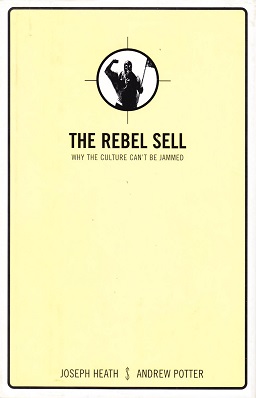
Joseph Heath and Andrew Potter, both philosophers, wrote a book about this in 2004 called “The Rebel Sell.” It’s available in the United States as “Nation of Rebels.”
The central theme of the book is you can’t rage against “the system,” or “the man” or “the culture” through rebellious consumption.
Here’s the conventional thinking most counter cultures are founded upon:
All the interconnected institutions in the marketplace need everyone to conform in order to sell the most products to the most people. The media through press releases, advertising, entertainment and so on works to bring everyone into homogeneity by altering desires.
To escape consumerism and conformity, you must turn your back and ignore the mainstream culture. The shackles will then fall away, the machines will grind to a halt, the filters will dissolve, and you will see the world for what it really is.
Finally, the illusory nature of existence will end and we will all, finally, be real.
The problem, say Heath and Potter, is “the system” doesn’t give a shit about conformity. In fact, it loves diversity and needs people like hipsters and music snobs so it can thrive.
For example, say there is this awesome band no one knows about except you and a few others. They don’t have a record contract or an album. They just go out there and play, and they are great.
You tell everyone about them as they build a decent fan base. They make an album which sells enough copies to allow them to quit their jobs. That album gets them more gigs and more fans. Soon, they have a huge fan base and get a record contract and get on the radio and play on “The Tonight Show.”
Now, they’ve sold out. So you hate them. You abandon the band and go looking for someone more authentic, and it all starts over again.
This is the pump by which artists rise from the depths into the mainstream. It never stops, and over time it gets faster and more efficient.
Unknown bands are a special sort of commodity. Living in a loft downtown, wearing clothes from the thrift store, watching the independent film no one has heard of – these provide a special social status which can’t be bought as easily as the things offered to the mainstream.
In the 1960s, it took months before someone figured out they could sell tie-dyed shirts and bell bottoms to anyone who wanted to rebel. In the 1990s, it took weeks to start selling flannel shirts and Doc Martens to people in the Deep South. Now, people are hired by corporations to go to bars and clubs and predict what the counter culture is into and have it on the shelves in the cool stores right as it becomes popular.
The counter-culture, the indie fans and the underground stars – they are the driving force behind capitalism. They are the engine.
This brings us to the point – competition among consumers is the turbine of capitalism.
Everyone who lives above the poverty line but isn’t wealthy pretty much has no choice but to work for a living doing something which rewards them with survival tokens.
Working as a telemarketer, for example, allows you to have food, clothing and shelter, but doesn’t put you directly in charge of creating, growing or killing those things you need for sustenance. Instead, you trade in tokens for those things. As a result, you have a lot of free time and some leftover tokens.
We don’t directly compete with each other for resources like we did for the millennia before mass production.
Before this setup, people were often defined by their work, by their output. The things they owned were usually things either they handmade, or were things other people made by hand. There was a weight, an infusion of soul, in everything a person owned, used and lived in.
Today, everyone is a consumer, and has to pick from the same selection of goods as everyone else, and because of this people now define their personalities on how good their taste is, or how clever, or how obscure, or how ironic their choices are.
As Christian Lander, author of “Stuff White People Like,” pointed out in an interview with NPR, you compete with your peers by one-upping them. You attain status by having better taste in movies and music, by owning more authentic furniture and clothing.
There are 100 million copies of every item or intellectual property you can own, so you reveal your unique character through how you consume.
Having a dissenting opinion on movies, music or clothes, or owning clever or obscure possessions is the way middle-class people fight each other for status. They can’t out-consume each other because they can’t afford it, but they can out-taste each other.

Since everything is mass-produced, and often for a mass audience, finding and consuming things which appeal to your desire for authenticity is what moves these items and artists and services up from the bottom to the top – where it can be mass consumed.
Hipsters, then, are the direct result of this cycle of indie, authentic, obscure, ironic, clever consumerism.
Which is ironic – but not like a trucker hat or Pabst Blue Ribbon. It is ironic in the sense the very act of trying to run counter to the culture is what creates the next wave of culture people will in turn attempt to counter.
“I think ‘sell out’ is yelled by those who, when they were selling, didn’t have anything that anyone wanted to buy.” – Patton Oswalt
Wait long enough, and what was once mainstream will fall into obscurity. When that happens, it will become valuable again to those looking for authenticity or irony or cleverness. The value, then, is not intrinsic. The thing itself doesn’t have as much value as the perception of how it was obtained, or why it is possessed, does.
Once enough people join in, like with trucker hats or slap bracelets, the status gained from owning the item or being a fan of the band is lost, and the search begins again.
You would compete like this no matter how society was constructed. Competition for status is built into the human experience at the biological level.
Poor people compete with resources. The middle class competes with selection. The wealthy compete with possessions.
If you live in a jungle and forage for food between spear-sharpening sessions, you compete for status with talent or prowess or…something.
If you get a paycheck, someone out there is buying what you are offering. You are selling – they are buying.
You sold out long ago in one way or another. The specifics of who you sell to and how much you make – those are only details.
Links:
Audio of a presentation given by Potter and Heath
Great Interview with Christian Lander
Trackbacks
- Fanboyism and Brand Loyalty « You Are Not So Smart
- Fanboyism and Brand Loyalty « Learn One Thing a day
- Fanboyism and Brand Loyalty [Fanboys] | Tech Gadget Reviews
- Fanboyism And Brand Loyalty | Gizmodo Australia
- Shotokan Karate - 24 FIGHTING CHICKENS
- Fanboyism and Brand Loyalty | K e s s l e r K o m i c s
- All Around the World News
- Counter-Culture As The Engine Of Capitalism - 25 Popular Blogs - Popular Bloggers.com
- Sneering at dissidents: spiritual tonic for the modern bourgeoisie « the Apophatic Attic
- You aren’t as clever as you think you are… → St. Eutychus
- Gauche: First month. « No New Year
- The Search for Authenticity « Cogs and Gears
- Can I get a sample o’ that? « wat u sayin
- Dieresys » Blog Archive » Links
- Selling Out
- Buying Yourself to Sell Yourself: And Why You Shouldn’t Care - film315


Just diputing that last ethnocentric comment about hunter-gatherers:
“If you live in a jungle and forage for food between spear-sharpening sessions, you compete with talent or prowess or…something.”
If you look beyond present-day industrial societies, human society is not necessarily characterised by competition. Many small-scale societies have levelling mechanisms that discourage competition for personal gain, while encouraging effort for collective gain.
Famous example was when a European bought a fat ox as a christmas present for an African group. They kept insulting the ox, saying it was skinny and would taste horrible. They ate it, it fed the whole group until they were stuffed. The men always belittled impressive game in order to stop people becoming egotistical and competing for status.
Classic example of pyschology only taking modern societies as relevant to its theories, and then projecting its theories onto humanity as a whole.
The pedantry is only worthwhile because our ideas about human nature not only affect how we understand our own lives but how we imagine human potential and the future. So the social world need not necessarily revolve around competition for status, it just does at the moment in most of the world.
Apart from that, great post.
Interesting comment.
I would like to avoid ethnocentric reasoning on this blog, but, I too am not so smart.
I suppose my aside about hunter-gatherer societies wasn’t really fleshed out. I meant to say competition for status was a universal mental struggle. Some societies, as you suggest, handle that innate tendency better than others.
The point I was trying to make was awareness of status and responses to that awareness are both universal features of culture across all eras and cultures.
The larger the population, the more inflated these behaviors become.
Jonathan Haidt said culture is just society’s way of reducing selfishness (or something like that).
I’m adding the words “for status” to that sentence, as current evolutionary psychology posits this.
Thanks for reading.
Of course, few things are as ethnocentric as cherry-picking famous anthropological anecdotes and then universalizing them in order to reinforce the “noble savage” stereotypes central to the “neo-primitivist” subculture, which tries to escape the trap of western subcultures by exotifying to achieve authenticity….
I think David’s thesis stands more intact without this particular excursion. ;)
(Or, in other words, my subculture can out-authentic your subculture. Neener neener neener.)
~foxy
well put foxy.
To “hi”: maybe status in the African group was achieved by denouncing status seeking. Some people are vain about their lack of vanity.
Brilliant article. My only qualm is that I am not sure all of this behavior is purely about competition in the most general sense. It seems to me that the counter-culture is not so much an attempt to out-taste someone else as it is an attempt to define oneself. While it may be for social purposes (sex, of course), it might also be something more personal than that.
Like you mentioned, we are no longer a species that creates out of necessity or even for leisure. Instead, we consume. So when we latch onto these counter-cultural ideals, we are defining ourselves as unique and important. We are trying to prove to ourselves — just as much as to anyone else — that, despite the hordes of people walking around, we matter. In smaller societies, this isn’t necessary. It is much easier to feel important when your village only has 50 people in it. In such a society, pretty much everything you say and do is unique. But, in a society of millions (or billions), connected in every way possible, blending in feels terrifying.
That’s why — when that indie band becomes popular — these people feel lost. Now that everyone has identified with the band, it becomes useless as a way to distinguish oneself from the crowd. Ultimately, the market is just catering to people’s desire to be unique, not necessarily to compete (although these may not be mutually exclusive).
Anyway, good stuff.
Heya, I just wanted to add something:
http://en.wikipedia.org/wiki/Jamais_vu#Linguistics
http://en.wikipedia.org/wiki/Semantic_satiation
Perhaps in a sense this is also why a overly popular (saturated) indie band is more difficult to define one’s identity by because the ‘form’ of the band, its name and brand, is everywhere, while the core experience remains an entirely individual experience.
E.G. The satisfying feeling of completing a full listen to a great album (understanding the meaning behind a word) can ONLY be experienced individually, while the promulgation of the name and keywords (the word’s “form”) attempting to describe the experience (which due to limited words in language will, by nature, end up cliched and overused) is by nature shared to anyone who is capable of listening/reading.
If I sound completely off my rocker I apologize, it’s the caffeine this morning. Regardless, excellent article! :)
Very well articulated…. Hats off…!
What if I really don’t give a shit about other peoples’ opinions?
Interesting… Try to figure out a situation where you really don’t “give a shit about other peoples’ opinions”. I’m trying ’til now, but it is quite difficult…
I would assume that you wouldn’t try to convince us that you didn’t give a shit about people’s opinions, since you wouldn’t give a damn what we thought of you.
Thats just what people say when they do care, but wish they didn’t.
well, that’s rather self-nullifying, isn’t it?
soliciting an opinion of you not caring about opinions. dividing by zero.
guys you missed the point, he doesn’t care about your opinions
Funny thing… when I didn’t give a shit about other people’s opinions, I anticipated fashions ten years in advance (and everyone laughed at me.) Now I just buy what’s on sale, because I’m old.
OK, here is an example of
Aha, I did that in secondary school when I listened to so much grunge music I refused to wash my hair for several weeks. I used to wear this battered flannel plaid jacket and the same style shirt and everyone, even the indie kids, called me “Lumberjack” for several weeks. I was poked fun at everywhere I went.
Fast forward to today and all the indie kids are wearing plaid shirts and refusing to wash their hair.
FML.
thank you – good article for a sunday morning to read
Just a correction: The Rebel Sell is the original title of the book in Canada (Potter and Heath are Canadian) and Nation of Rebels is the title in the US and a few other countries. It’s still in print and very much available for purchase and an AWESOME read.
http://rebelsell.squarespace.com/international-editions/international-editions/
Oh, my bad. I’ll fix it.
For those interested, Dave Eggers wrote an amazing essay on the concept of selling out in an interview with the student paper at Harvard. He didn’t hold back on the poor sap who asked the question:
“You simply cannot judge someone, especially someone whose work you have respected, when they disappoint you, superficially, once or twice. Think of the fuckheads who turned their back on Dylan when he started using electric guitars, for Christ’s sake. What kind of niggardly imbecile would call Dylan Judas when he plugged into an amp? What kind of small-hearted person wants an artist to adhere to a set of rules, to stay forever within a narrow envelope which we’ve created for them?”
http://www.armchairnews.com/freelance/eggers.html
Thank you. I love Dave and consume his wares with tree-killing abandon.
Great post. I wonder if the truth is that no matter what you are always selling out though. I think you’re right in saying that often times in attempting to rebel, people are simply selling out to a different group. However, if you truly recognize the endless push to consumerism that advertising and corporations drive, I would argue that the best response would be to simply buy less and be happy with what you already have.
It’s a little harder to apply to clothes, which is a fairly common form of expression when it comes to rebellion, however the act of consuming less and as a result working less is really a way of exiting the market economy (or at least decreasing your participation). Of course that gets into a much more complicated argument about what makes people happy and whether buying more things that ‘fit’ them actually makes people happy.
Another important point that comes up is that if you recognize that you are allowing your happiness to be defined by comparison, then you should strive to avoid comparing yourself to others. I think it goes along with the whole buddhist train of thought that you define your own happiness etc. etc. After all I think the whole action of comparing and seeking status is somewhat irrational (though it probably stems from the evolutionary desire to show off for your mate). After all if you are allowing yourself to be less happy with what you have because of someone else’s possessions you’re giving them undue influence over your happiness.
Of course no matter what it is difficult to escape markets on the whole because our lives are so intricately interconnected with them.
At the height of the 2008 financial crisis, The Economist published a cartoon which put it quite aptly:
http://media.economist.com/images/20081018/D4208WW0.jpg
This entire subject can be inflammatory. One problem I have noticed over the past several years, and growing steadily, is the rush to judgment that many people feel entitled to pass on others who’s world-views might be different than theirs. Does having money and spending it as one chooses necessarily make one a ‘bad’ person? It does in the eyes of many. If we choose to eat at McDonald’s, whether as a routine or occasionally, we are judged lacking. If we choose to smoke, we are seen as horrible people. If we drink sodas, there will be someone out there deriding us for our choices. I feel ‘my money, my choice’. I am NOT a ‘bad’ person if I want to buy an expensive ‘gee-gaw’ that I don’t actually ‘need’. This does not mean I don’t give money to charities or others in need. However, today it’s the ‘fashion’ to let others know how ‘shallow’ and self-centered they are for purchasing anything that doesn’t fit in with today’s standards, whether it be a diamond bracelet, a pack of cigarettes or a cheeseburger and fries. It all ties in together. Other people are now allowed to rant against anyone who makes an unhealthy life-style choice or spends dollars on fancy jewelry, cars or upgraded kitchens. I say ‘enough’. Why can’t everyone simply mind their own business? My choices do NOT affect you…and, no, I do NOT want to hear about your tax dollars going to pay for my poor choices. I have worked my entire life, and put more than enough money into the system (along with having private insurance) that MY care will NOT come out of YOUR pockets! I don’t feel that I’ve ‘sold out’ by my choices of which consumer products I buy. I make my choices by what appeals to me. Nobody is influencing those choices except myself. I’m intelligent enough not to be fooled by the hype. So, please, stop your preaching (not the author of this piece, but all of you out there who yell at anyone who dares make a choice different than your own!) Worry about your own lives, and what you do with your own money, and I’ll do the same.
I would argue that a person’s choices do affect others if they are choices that result in, for example, unnecessary environmental damage, such as buying bottled water to keep in the fridge at home instead of drinking tap water if you live in a “safe” country, and then, additionally, not recycling the bottle.
(Not necessarily the best example but hopefully good enough to make my point.)
Couple things…
@Carolina: When you say “My choices do NOT affect you”, that’s a level of obliviousness you’re encouraged to take when you live somewhere that champions “freedom” far more than it does responsibility.
Fact is, many of your consumption choices *do* affect people.
And it really, truly matters that you can’t or won’t fathom that fact.
Buying a cell phone makes a statement. It indicates both the depth of your knowledge and the breadth of your values.
If, as is often insinuated in market economies, you knew something about the phone (sellers are supposed to be knowledgeable after all right? You know – “rational”?), you would have to know that many of the materials of that phone are mined. Mining is without question the dirtiest industry in the world. It is often the worlds poorest people who are obliged to labor to do it. And likewise, it is often many of the poorest states that are either coerced through market mechanisms or the threat of violence to open up their natural resources to extract those minerals. So you would (and likely do) know that somewhere on this planet,a forest is scraped away and a mountain is levelled and formerly clear waters are polluted for generations to make a phone that is a few years will occupy a dump site, that will be transported somewhere else where people are so poor they subsist on scraping out the guts of that phone, so a few less grains of that mineral can be sold to make another phone, etc etc etc.
Once you begin to slide down that path where the only “recognized value” of a thing is in their dollar value, the value of existence itself is polluted. In essence, you admit that nothing has an inherent value in simply existing *for its own sake*.
So you feel a bit bad and toss a few dollars at some “Save the Polar Bears” thing and tacitly give weight to the same system you found allowed you to buy a phone… you’ve just put a monetary value on animals, haven’t you?
If that’s not an impoverished value system – I honestly don’t know what is.
And the sad thing is, @mjw more or less reveals the polluted value system when they (perhaps inadvertently) say “unnecessary environmental damage” – because mjw has overtly stated what many of us covertly know – that *something*, somewhere *must* be destroyed so we can have our toys.
Personally, I believe humanity is headed for a train wreck for these very reasons. We’re so bereft of imagination and will and so lulled by the offshoring of the necessary ugliness of a consumptive world that we will, by God, take the whole place down with us, so somebody’s kid can have their freaking Care Bear.
Even as an avid punk rock kid in high school, I noted with amusement how much STUFF was for sale in the pages of Maximum Rock ‘n’ Roll…
I don’t believe this tendency is “human nature”- what the hell is human nature, and if it existed, how could we know what it is. I also don’t think its necessary to see the drive to consume “difference” as a “bad” thing. I think that the market provides us with opportunities to build a sense of identity. If buying an imac over a PC allows us to feel unique and smug about how great our choices are, at the same time as fueling the market, then I don’t think that has to be a bad thing. Especially as so many of the cool kids are feeling smug about their eco and fair trade choices these days… Isn’t it possible to be aware of the system, and yet still partake in it on some kind of super hipster meta-ironic level? That’s what I will tell myself when I go shopping tomorrow ;)
I agree.
Improvements can be achieved by making actual more-sustainable practices “cool,” which is the winning strategy a number of people interested in a more sustainable society have adopted.
The Sex Pistols.
‘Nuff said.
“Fight Club” actually made this exact point. Exactly. But I agree that a lot of people didn’t get that out of it. If it had just been an anti-capitalist screed it would have ended with them blowing lots of stuff up, rather than discovering the two distinct personalities of the sell-out and the rebel who could only exist because they didn’t know of the other’s existence.
I guess I agree with the sentiment, but I don’t agree with the logic; it defines “selling out” too broadly, essentially boiling it down to “participating in capitalism” or “consuming goods.”
That’s kind of an absurd definition, since only people who grow their own food, extract their own water, and have no use for electricity or gasoline can truly divorce themselves completely from capitalism or consumerism. Those kinds of people don’t exist in the U.S. because they still have to pay property taxes and are regulated by the government (even if they aren’t market participants in any way whatsoever, there’s a famous Supreme Court case from the 30′s about this), so they always have to end up “exchanging survival tokens” or whatever.
If that’s the main aversion to “selling out,” being a market participant, then yeah, all this seems true. But I don’t think that’s what it is, because it’s so obviously impossible.
Instead, I think “selling out” is not about the simple fact that you’re buying *any* music or shirts or movies. It’s about *who* you’re buying them from. So if you buy your Ramones t-shirt from Hott Topik or whatever, the “evil greedy corporations” are the ones who directly end up with most of those survival tokens, while if you buy your Crass t-shirt from the merch booth at the back of the tiny club you saw them play in, then the humans themselves are the ones who directly end up with most of them.
That’s all still practicing capitalism, no duh, and just *existing* in the US requires you to practice capitalism. How you practice capitalism, though, and who you help profit by consuming goods, is what the punks are saying is important (or should be saying, if they actually thought their rebelliousness through).
I still think the concept of selling out is stupid, but not for your reason, which I think is equally as stupid.
I’m not so sure that “only people who grow their own food, extract their own water, and have no use for electricity or gasoline” can “truly divorce themselves completely from capitalism or consumerism” either.
At the base level, human beings consume resources in order to survive, and there is always a finity to the amount of those resources available. It’s possible to reach an equilibrium where things consumed are renewed at an equal or higher rate to the consumption, but consumption still can, and must, occur, for biological processes to continue.
This is why I’ve come to think of the entire “anti-consumerism” mindset to be inherently flawed, when instead what we should be focusing upon is how to make our consumption sustainable, both through reduction of total consumption levels and improvement of resource-extraction methodology to reach a point of sustainability.
The only way to stop being a “consumer” is to be dead. Then you become part of what is being consumed.
~foxy
Well put foxy. The key isn’t anti-consumerism, it’s utilitarianism.
And Paul Stevens, I agree w/ you that the definition of “selling out” is too broad in this article. To me it means going from offering smart, subtle, good art that only a few people “get” to offering dumb stuff for the masses for the sole reason of making more money.
It’s also worth pointing out that small-scale, subsistence agriculture is not necessarily any more sustainable than large-scale commercial agriculture. If we try to revert to an “every-family-for-itself” methodology of survival we’re going to make our presence on the planet heavier, not lighter, due to the loss of economies of scale.
Well argued, Stevens. Supporting local economy and supporting sweatshops is not the same thing. “Selling Out” seems more accurately to refer to buying status without regard for the cost to the environment, exploited labor, and to small businesses. It’s a dire mistake to dismiss all criticisms of consumerism as equally superficial.
What you’re writing here seems quite similar to Laibach’s philosophy :)
ever listened to cake’s building a religion?
yes, it basically sums all of this up to an awesome beat. btw it’s called comfort eagle
Not all counter-cultural types are socialists or anti-capitalists. Even plenty of hippies and punks were and are pro-capitalism.
Hell, even the Soviet Union spend most of its history buying American commodities and other products.
When people say that someone “sold out,” it usually means that they abandoned their core niche to reach out to a broader market. That’s a legitimate consumer complaint. It comes up all the time.
You’re post is interesting, but I think you make a huge mistake between culture and consumption. You’re example using indie bands is disturbing: the creative drive behind them has nothing to do with some fat-cat Tony Mottola putting together a boy band in order to move propaganda and create a trend that will sell millions of records.
Yes, the *economic bottom line* might be the same: Invest in Radiohead, make a buck. But comparing “O.K. Computer” with anything by Britney Spears is ridiculous. Reducing Radiohead’s influence on contemporary music to their ability to move markets is very short-sighted, if you ask me.
OTOH, I found it funny you seem to state a case for capitalism and free markets while using Marx’s distinction between “work” and “trade”: “Before this setup, people were often defined by their work, by their output”. This was extensively explained by Hannah Arendt (“The human condition”), but I suppose you already know that.
Pardon my mistakes and all, not a native-English speaker. I’m from Venezuela. It might interest you that the same case was made about 20 years ago by a Venezuelan sociologist: “Del rock a la postmodernidad” (from rock to postmodernism) by Luis Britto García.
Cheers
Sure, fashion and entertainment are the only industries that constitute capitalism. Maybe your next post should be on straw man arguments.
I hope this was an attempt to be terribly clever by proposing the straw man that this post is a straw man. How adorably postmodern. :)
If his comment was a strawman of a strawman then yours is a strawman or his strawman of a strawman. Which would make you post-post-modern, and that makes me post-post-post modern, which is apparrant in my self-reflective criticism of- *implodes*
Interesting read, though I don’t completely agree with his thesis. Yes, historically people have competed for status. However, corporations have gotten very good at creating demand and you even hint at this in your blog post: “Now, people are hired by corporations to go to bars and clubs and predict what the counter culture is into and have it on the shelves in the cool stores right as it becomes popular.” This process has been dubbed cool-hunting and if corporations don’t actively search for the next trend and stock store shelves with products reflecting these trends, how will the next wave of mainstream be created? That being, if stores don’t supply the goods, how else do the masses buy them in order for the trend to become mainstream? It’s seeing it in stores, seeing celebrities endorse products, and a variety of other advertising/corporate tactics that really sustain consumerism.
On another note, there is another form of counter-culture called downshifting which isn’t about being cool and having an image, rather, actively choosing to limit one’s consumption. This is definitely not something “cool” in the sense that it’s visually appealing or edgy. On the contrary, it’s simply buying less and being content with that. So not all counter-cultures become the next wave of what’s hip and not all counter-culture is driven by status.
If you think that “downshifting” is not an attempt to gain status amongst the peer group that has defined doing so as desirable you are lying to yourself Mike.
PS, Fox M Circe, who cares if the motive is to “gain status” or not? The less crap you buy the less you contribute to and participate in the sordid consumer-capitalist menage. That’s a simple and effective equation any stylish radical can easily live by, and one that arguably makes a measurable impact on the big picture.
I didn’t say “downshifting” is not useful or desirible, but it’s also all about “being cool and having an image” contrary to your claim.
I’ve been choosy about what I sell out to, but I recognize I’m still a hypocritical sell out, as most of us responding here likely are.
I disagree with you here foxy. Existing underneath a culture lie the moral and ethical mores of those that truly shape it.
If I decide at an ethical level that I choose not to buy so much stuff to re-align my existence with what my being needs to exist, then I am not looking for status or image. I am looking to live responsibly. It is interesting (and somewhat unfortunate) that aligning my life with these values pushes me to the periphery of modern society.
Not belonging to a group/society creates anxiety and fear at an instinctual level. ‘Conform or die’ is part of our evolution.
This may be generally true, but it is not universally true as the language of the post implies. It is possible to buck consumer culture. It requires that our consumption choices be informed by ethical considerations rather than “style”. There are many choices we can make that limit our personal dependence on globalized consumer culture and our enabling of all of its bullshit and brutality. We can stick to fairly traded or local goods, organic, whole, local, and / or heritage foods, supporting small local businesses, doing more for ourselves and relying less on “products” (i.e. washing dishes by hand instead of buying a machine). The aim of the ethical consumer is to reduce her dependence on sociopathic global markets as much as possible and allow her choices to be guided by ethical rather than reactionary considerations. It is impossible to eliminate “consumption” altogether – every living thing consumes to survive – nobody really argues this would ever be possible, so the underlying concept of this post smacks of a straw man. It strikes me as an attack on young people who are beginning the process of questioning our society’s values but haven’t yet arrived at the realization it takes more than a completely black wardrobe to make a genuine impact. Given time, only a few might arrive at a more sophisticated understanding of “counter-culture”, but insisting there is no possible means of escape is simply irresponsible.
You’re still doing it.
By establishing yourself as an “ethical consumer” (whose ethics? There isn’t a universal set), you’re passing judgment on those who aren’t “ethical consumers”. By passing judgment, you’re establishing a hierarchy with yourself higher than the people who don’t behave the way you want them to. You are still seeking status even if you’re the only one who knows about the hierarchy.
Here’s an exercise: Is someone who only buys food created (grown, farmed, etc.) within 10 miles more ethical than someone who only buys food created within 25 miles? If so, there’s your hierarchy. If not, where does “local” start? Is it 100 miles? 1,000? If it’s “the food takes less than a day to get from there to here”, at what speed is it traveling? What purpose does setting the arbitrary boundary serve except to make you feel better about what you’re doing?
Don’t get me wrong. If you believe that being an “ethical consumer” (by your definition) is the correct way to live, by all means, live that way. But you need to be aware that (by David’s definition) you’re still selling out.
Well said.
Chris, it isn’t nearly as complicated as all that. There is no need to compare yourself to anyone. An “ethical” approach to consumption only requires that we establish a few core principles and allow these to guide your purchasing behavior. Some examples of core principles:
Exploitation of workers is undesirable.
Pollution is undesirable.
Some examples of resulting purchasing behavior:
Supporting fair trade.
Supporting organic, local and/or heritage food over GM or chemically treated crops.
Once you have established an ethical framework it is a simple thing to treat each purchasing opportunity as a conscious choice whether to endorse or reject the social and ecological cost of that particular product.
If you really think behaving according to a few simple guiding ethical principles is all about competition for status, I feel sorry for you. I can’t see any payoff for being so cynical about our liberty to choose freely and our power to effect change, and I see no empirical justification for it.
There’s no money-hungry corporate bloodhound that’s going to make a killing off of me not buying stuff, no matter how dearly some might like to believe there is no escape from the consumer-culture hamster wheel (unspoken subtext, “so you might as well just ignore the social and ecological cost of your behavior”).
I would also point out that, whereas most of David’s posts cite psychological or sociological research (which is why I love them so), this post references a couple of philosophers. Perhaps in this single case, instead of “The Truth” he could have written “My Opinion”?
Often one finds a measuring stick and uses it to measure EVERYTHING.
Satoshi Kanazawa, that complete and utter hack, thought that he could use the pursuit of sex as a measuring stick. You think that you can use status seeking as a measuring stick. I’ve also heard people explain carefully how everything you do is money seeking or happiness seeking.
People are complex systems. Some folks say they have become vegetarians because they don’t want to support eating or killing animals . There is very little evidence to support an assertion they are instead involved in status seeking. One can construct a logical chain of reasons from status to their action – but those chains are usually longer than the chain of “I don’t like what I read about the treatment of workers in factory X, therefore I’m not going to support that behavior with my money.” Occam’s Razor helps us in evaluating these claims, unless we are just seeking support for our already staked position.
The public display of information is much easier to trace back to status seeking, of course. Someone wearing a PETA pin or carrying a reusable grocery bag that proclaims “I am not a plastic bag” is making a statement about their values. It’s possible this is status seeking, but not certain.
I think I’m writing this comment because I like intellectual openness and honesty and the exchange of ideas. Of course, I’m just commenting on an old post on a website because I’m seeking status among my tribe of friends who do not read this website.
The way out: Define your personality and status based on who you are and what you do, not on what you own. Buy things purely based on functionality.
That’s what I’ve been doing.
I firstlearned of Edward Bernays while I was in college. He doubled the profits of the Tobacco industry by doubling the demographic, breaking the taboo against women smoking in public, among many other things.
The paradox most aware ‘socially conscious’ people arrive at when they start to consume less and create alternative economies/practices is when their eco/whatev beliefs DO get implemented by the masses it’s usually in a dumbed down form from the corporations, lip service if you will.
Consumerism, I’n my belief, is absolutely a necessary common thread, material comfort and desire replacing the void left in western society.
Bernays uncle Freud was a master manipulator but not off the mark entirely. Take a look at the 1939 NY World’s Fair, (which he was instrumental in bringing about) Edison and other top scientists and thinkers wrote messages to place in a time capsule not to be opened for 5000 years. Upon reading them, you can feel the tension in the world climate. The stock market crash was waning, but fresh in everyone’s mind. Fascism and hatred were being touted not only in Germany, even the US had many supporters of this view. “Herd Mentality”, people’s animal instincts.. Fight of flight. They are both extremely dangerous in human beings. Collectively we are capable of doing things that we would have never done. For most of us, our conscience would never allow something like the holocaust to happen, but it did.
I feel that until one has reached a stage of non-attachment or true understanding of the needs of society, It is better than the alternative.
The only issue we are about to face globally isn’t IF consumerism will replace other forms of social control in other parts of the globe, but WHEN.
Most scholars would agree that the resources needed to feed this are being stretched to the limit as it already stands by the industrialized nations.
Cottage politics and ‘granola’ industry means nothing on the global scale. Product placement and consumer theory were already in full swing in the 1920′s. These messages have reached all but the most remote places on Earth.
Think about the time it would take for TV/Radio signals to reach a distant star. Signals from the ’20 and 30′s have travelled millions of miles by now, but aren;t indicative of where we are currently as a society.
We can’t do an about face and change the message we have been sending to the rest of the world, especially when our own people/governments cannot agree on or reach environmental targets.
Bernays convinced more people to smoke to turn a profit, kept society docile with material things.
What would he do now?
my bad, it’s ‘Einstein’, not ‘Edison’.. 6am writing..eesh
I think it is high time we find a better word for artists/performers/etc who do “sell out”. We need a new term if this one is now defunct (and apparently always has been). A way to show your disgust at something like a “Green Day” rockband game for example.
I am glad SLC punk was brought up in this article because I think the end of the movie had the point of it’s not what you wear or the music you listen to or any of that crap. It’s what you believe on the inside.
Bizarro: Why do you need some catch-phrase to express your disgust at something, and what do you hope to attain by shooting a fish-in-a-barrel like Green Day?
Perhaps you should print t-shirts to show everyone who much more punk-rock you are….
Foxy~
“If you think that “downshifting” is not an attempt to gain status amongst the peer group that has defined doing so as desirable you are lying to yourself Mike.”
It’s certainly possible that there is an element of status in our downshifting decision (we are social beings and define ourselves through social interaction) but there are also many other elements to the decision as well.
“I didn’t say “downshifting” is not useful or desirible, but it’s also ALL about “being cool and having an image” contrary to your claim.
I’ve been choosy about what I sell out to, but I recognize I’m still a hypocritical sell out, as most of us responding here likely are.”
Careful with absolutes… All generalization are false… Including this one.
Again, it’s not ALL about being cool. It’s often about posterity, other species and biodiversity etc. Please think through your generalizations
Also, you’re pretty annoying in general (ad hominem yes… but I couldn’t help it, sorry)
I’d like to argue with you but I don’t really feel like wasting any more of my time… Please get some fresh air and don’t ‘consume’ entire message boards anymore
Silly. Hippie/Punk/Goth/Whatever portion of the consumerist problem = .0001%: Vast oil guzzling, coal spewing, environment eating, sewage spewing masses of baby-popping human masses = 99.9999% of the problem. This article is either scape-goating or self-loathing or both. The whole concept of selling out is ridiculous in this context because first you have to buy in first, kids buying a few Che T-shirts kinda misses the point.
Gary
Most of your points are pretty obvious to me. Of course things only have value because we apply it to them. Of course companies are selling stuff because it’s trendy to reach higher sales. Of course “counter-culture” is an important part of our culture.
I don’t, however, think that hipsters are the engine of consumerism. They are the fuel. They make the engine work, but don’t want to be consumed by it (though they inevitably are).
Also, people usually use the term “selling out” to refer to choosing money over their values, not just gaining money for work.
Interesting read. Could use editing (see: “all of the sudden”).
The Joneses(or Smiths, or McMuddles, or Crowspoodies), next door are the new tribe, the new competition. The competition now is social superiority, or even just social parity. Most of us NEED little beyond food ,air , and shelter, but we think we need more, because, as a species we can’t not compete.
It’s probably a genetic/sociolgical hangover from when hunter/gatherer was the only option.
Any successful corporation grokked this a long time ago, and ran with it, ’til they owned their customers.
#end of moderately mindless diatribe#
That’s a great point–one that might not be as obvious to *everyone* as ’tis to Nicole :p–but I am still left wondering just how natural this insane competition over status really is. I suppose the need to collect just a few more stones than the Joneses is endemic to human civilization, as the historical record amply suggests, but I don’t think the colossal modern expressions of that need are necessarily natural or self-driven. Put another way, I would say it’s certainly true that demand drives the economy, but the problem today is largely the extent to which producers are creating new “needs” which must be filled. The dragon is biting its tail, so to speak–the demand is now being manufactured just as prodigiously as the product, and we’re not dealing in trinkets anymore.
One example of this might be the automotive industry in the U.S. throughout the 20th Century, a paradigm which has since spread to most of the rest of the world, though scarcely elsewhere with the sheer amount of testosterone and hedonism we’ve seen here. The automotive industry was built upon the increasing availability of cheap resources at the expense of the developing world, and this led to suburban sprawl, which has led to an ever-greater need for cheaper resources at the expense of the developing world. The automobile began as a weekend-pastime status symbol, and evolved into a way of life, but I’m not sure competition over status really drove that explosion very far.
Anyway, the salient thing, in my view, is your simple and elegant observation that counter-participation is not a viable alternative to non-participation; but non-participation in certain areas is extremely difficult, damn it!
Reminds me of this picture:
http://www.truthdig.com/cartoon/item/20090112_non-conformist/
How have communists (like hippies) bought in? (I’m not talking about posers). Even more to the point, modern homesteaders who live off the grid without social supports. My point is, there are indeed people who live outside the rat-race. Otherwise I think this is not only accurate but fulfills the intent of Art to shake people’s perceptions.
Author, that’s a lot of fancy talk coming from a sellout poser. why don’t you go jerk off while reading Wealth of Nations and stop wasting peoples time with your babble. Bottom line you’re not a psychologist, you’re not an economist you’re a journalist. stop trying to pretend you know Why and just stick with What.
kthanxbai
/DIAF
“Competition for status is built into the human experience at the biological level.”
oh cool, i guess i’m not the only pretentious asshole who doesn’t have a degree in cultural anthropology…
In the Rebel Sell, the author’s laid down a fairly basic tirade, illuminating the eventuality of all goods and services being co-opted into capitalism. Including the arts and sciences which are integeral for personal development and happiness. This is the main issue.
But, this only presents a problem, if you are middle class, and selecting modes of self expression (granted vicariously) through media. In other words, if you buy into exclustivity, and therefore the concept of cool. If you can magically see beyond, or are self actualized, maybe have a peak experience, or drink some spiked cool-aid, you can go about merrily aware of this fact, and not bothered by it.
But if Maslow’s hierarchy be correct, we are all fucked up on the second tier because of:
Counter culture. The very mechanism created to ascend said ladder. Or pyramid, or what have you.
Which is why Hipsters invented their particular brand of irony (which isn’t ironic at all – wait, does that make it irony after all?). Anyhow, it could also be from laziness, but recycling old trends and pretending to be kidding about the whole affair – is so neurotically cowardly, I cannot begin to fathom a decent metaphor to further express my distaste.
Hippies were a silly bunch, but at least they failed ( if you believe they did, in fact, fail ) honestly, and with heartfelt abandon. Not like a psychopath on anti-depressants avoiding every chance to fit in – casually not fit in.
So the author’s proposed a solution. Fit in. Fuck it. Shut up. Fit in. Wear blue jeans and tee shirts. Comb your hair. Get a job. Shop at Walmart. Wear a blue jumpsuit, I think was the idea, but that isn’t very seasonal. So amend it, but keep the spirit.
Create art, instead of consuming it. And fuck Andy Warhol. He just wanted to be loved.
You missed the point. The author trying to convince you to fit it, he’s saying that that there is not “it” to fit in to.
Yeah… this has been said many times before. You’re doing the same shit as the people you’re blasting. You’re just trying to make yourself seem like you’re the rebel and therefore one who REALLY knows whats going on. All to give give yourself reason to those around you to believe that you’re intelligent. Let people act how they want to act. If their way of dealing with the bullshit of society is to buy anti-establishment clothes then let them! It is a lot less destructive than picking up a gun or drugs and dealing with it that way.
@bob I am as guilty as anyone for the things described in this article and in all the posts on this blog. I am not so smart.
I own the Rebel Sell and I am what you would consider a indie, hipster who is merely self perpetuating into the capitalist consumerism that I so consistently rail against. You do make some great points in this article but I feel your thesis may be slightly off. I believe that as we have seen since the 50′s and the beatniks, the will always be “true” rebellion, such as Jack Kerouac, who flaunt all the rules and truly “rebel” against the cultural norms and expectations, however because this idea of rebellion is so highly sought after by many other people it has the ability to be bought and sold. All counter – cultural movements begin and end this way. A seemingly disenfranchised group of young people find a way to express themselves in a way they deem unique. That uniqueness is what every generation has been searching for, a way to separate oneself from everyone else. And it is what every business in the past 60 years and more noticeably the past ten, has tried to and for the most part succeeded in commercializing and selling it to those who desire to be unique. I believe this is a product of our capitalist culture. We believe that we are defined by the things that we buy, so we buy everything that we feel fits us, or makes us unique. I do see it as a problem both with the consumers and with the sellers, so I will not solely put the blame on the corporations. The average consumer of these products is blindly buying the idea that their belongings define who they are. That they are not true to themselves if they don’t spend copious amounts of money on items deemed “cool” and “indie”. This is what is really going on with this and every “counter-cultural” movement, it is bought and sold. It gets de-clawed and de-fanged by people who don’t understand the reason for the cultural shift but rather are just following the crowd. Really it all stems from people not being honest with who they feel they really are. Listen to the music you like, like the movies you like, don’t define yourself by what other people like or with what you buy. Don’t let your belongings define you but rather define your belongings based on who you are.
Sorry this was kinda all over the place I have a lot to say on the subject which is why I am going to get my masters in sociology so that I can study these kinds of things. My advice, if you are willing to take it, is too re-read the Rebel Sell, I think they make some great points and it is great, especially for me, to hear from the “other” side but I think they are too caught up in what the point they are making, they are not objective enough in their analysis and it appeared to me when I read it that rather than find a theory for the data they found data to fit the theory, kind of like your article on confirmation bias. :)
Anyway have a great day hope to hear from you and keep up the great work this site is getting bookmarked!
@abrutalkind – Nice comment. Good luck to you on your way to being a sociologist.
Hey, good summary on consumer cultures.
Something I find ironic (and not in the consumer sense) is that people constantly speak of Corporations as the driver of mass consumerism, forcing us to ‘BUY BUY BUY’ in a never ending grab for our hard-earned dollars. The ironic part for me is this – Who do you think Corporations employ to do their dirty work? It’s us of course. You and me. The regular guys. We work as advertising executives, copy writers, department store assistants, petrol station managers, fast-food cooks, delivery drivers, cleaners … the list goes on. Corporations don’t run themselves, and they have no intrinsic power to control how we live our lives any more than a coconut tree does.
And yet the idea that Corporations wield this uncontrollable power over our free will still persists, and seems to be continually enhanced and magnified with each generation born into the capitalist system.
Instead of asking your neighbour why he bought the brand of car he did, ask yourself why you wear the brand of shoes you do, or why you have the style of haircut you have. Then ask yourself if you are one of the mindless Corporate drones or if you are one of the outsiders. Be the change you want to see (Am I a sellout for quoting the Dhali Lhama?)
Just stopping by to let you know that I enjoyed the article, but there was a problem. You said that the ‘free market’ is getting better and more efficient at providing people’s wants and needs. This is not the case, since we don’t actually have a free market, but a mixed market. You can’t sling the term ‘free market’ around like this, this is a rotten corruption of the actual meaning of the term and sets back the progress that people aiming to advance these ideals have been making.
@DEI – Interesting point. I suppose the term “marketplace” would be a better fit.
hmm..you’re generalizing much more broadly than the historical facts warrant. your focus is on youth counter-culture, much of which itself is valid. but, teenage rebellion is a 2oth century phenomenon and the historical antecedents of capitalism go back much further. there must be more going on here than your analysis suggests. in short, you’ve confused cause and effect. the manufacture and commodification of identity is an effect of capitalism that re-enforces the system that created it.
more importantly, this has been said before and said much better. naomi klein said this much better and with much better research and analysis in a chapter entitled alt.everything in her book No Logo.
@Jim – My focus here is on “selling out” in the way the term is used in modern Western culture. I’m not taking the long view.
I haven’t read her book, but I certainly will add it to my wish list. I am skeptical of the No Logo movement though, as it has been absorbed into the market exactly as I describe in my post. They sell all sorts of products now with the No Logo branding. “The Rebel Sell,” which is launching point for this post, specifically criticizes the tenets of the No Logo movement.
Teenage rebellion is a 20th century phenomonon? I seriously doubt that.
Fashion is just things that aren’t dumb yet, but will be.
The whole notion of fashion is dumb.
Youre the one with the birans here. Im watching for your posts.
I fail to see how making your own clothing out of rags and safety pins makes you a sell-out. Or one step further: f-in’ starting your own solar-powered commune / organic farm. I mean, sure, they’ve got to buy those solar panels from someone…but…that’s not what you’re talking about here.
You seem to be confusing the originals for the copy-cats. Copy-cats always miss the point.
I steal everything I own, all movies I watch, all music I listen to. The clothes I buy are from non-profits. I dumpsterdive all my food, and what I don’t dive for is given to me. The electricity and internet are free in the squat I’m in. So whom I pray you tell me is getting fucking rich from me????
@chinneths – How are you posting this comment?
@Joe Blow
Seconded.
1. Fight Club was actually a box-office flop whenever it came out.
2. This article is only touching on the superficial acts of rebellion. It doesn’t even stop to consider that the idea of being a rebel is about philosophical ideas and not about wearing stupid-ass clothes for the sake of making yourself more of an outcast.
Some people reject the mainstream because they have problems with certain aspects of it, but not its popularity.
I’ve fallen in love with small time bands only to see them grow more popular and eventually get signed.
I didn’t pout and cry and call them sell outs, I clapped because something I liked got to reach more ears.
This article isn’t so smart.
Only stupid, superficial people care about selling out. The real rebels who actually back the ideals of the subculture will be glad to see their ideas and tastes take a hold of society.
More often than not, though, only their clothes do.
HOWEVER, before I leave here sounding like a rude asshole: I must say that I’ve enjoyed many of your other articles, and I’m aware that you’re a journalist and not a scientist.
Too much Greed will fuck the world
today is like pissing in the wind
if some twat wants more stuff, someone else has to pay
@chinneths
You sound like a worthless piece of shit leech who doesn’t contribute a damn thing to anybody. Go crawl back into your hole until you figure out something of value to do with yourself.
Hm..what does that make someone who strives to consume our society’s leftovers. Just because most of us our somewhat involved in the system, doesn’t mean that we should just give up on consuming less. I also think this article oversimplifies class differences as many middle class over consume without high value on taste and any rich are very into taste. Also if a product is more ethical because the consumer demands it that is changing the machine for the better and a very powerful thing.
Article largely rings true, but Iggy Pop selling insurance still feels like the ultimate in selling out.
I´d think, that selling out would probably only apply to hippies, and punk rockers. And the real, ¨hard to the bone¨, punks and hippies buy their clothes/stuff from thrift shops, or make them themselves, or buy from other punks/hippies, who buy materials from other hippies/punks. Selling out would mean breaking this chain, and profiting someone outside of the subculture and probably rich/aiming to be rich.
A great article for stimulating thought and debate, done with many truthful and good points, however, in much the same vein as those who “will defend their ego no matter how slight the insult” this article struggles all along to justify its main theme and doesn’t really come through.
The rejection of consumerism is there and exists. Whether the expression of that sentiment is later hijacked by the “entrepreneur” or the crowd is moot. The original sentiment is genuine and cannot be subverted.
Is an ascetic that buys a loincloth a sellout? That would be silly.
competition is not built into us at a biological level, its taught. i liked the rest of the article though. except that bit.
This article is a fairly sub-academic, psuedo-intelligencia article. It’s preaching to hipsters who line their shelves with Chomsky but have never heard of Gramsci. It reads like it’s supposed to be an all-knowing exposé of counter culture, pissing on the bonfires of the left wing. It starts with the grand exclamation that “both consumerism and capitalism are sustained by corporations and advertising” is a falsity. And how does it prove this misconception? By meandering through fairly standard coffee shop arguments about buying t-shirts with logos and selling out.
I realise that the audience here may feel like they’re well read and intelligent because they they watch Jon Stewart, and prefer British comedy to American stuff, but the fact is the article in no way reveals anything to counter that first ‘misconception’. A wee bit of biology at the end, a rash generalisation about human nature, and you’ve apparently sealed the deal.
But really, the fact that you’ve taken the time to write an article on capitalism, but you can’t even think or provide examples beyond the limited field of bands selling out, shows how unresearched this is in the whole scheme of things.
I don’t mean to be an arse, and I really don’t mean to be so condescending. And the debate here might prove fruitful. But when you’re dealing with something as large as captalism and human nature, a hipster article ridiculing hipsters really shouldn’t over think its importance.
The fact is, we all live in a society shaped by the corporations. But the corporations are shaped by us. Deal with it. But these acts of rebellion and counter-culture, and any argument involving these, don’t deal with the real issue.
The real issue is the inherent inequality that the capitalist sytem bestows upon society. A “free market” creates a free society apparently; however only if at first we were all equal. But through thousands of years, elites have asserted social dominance on the population, from the pharoes to the industrialists, and the neo-liberal capitalist elite is just the latest incarnation of this social dominance. You can’t say that capitalism doesn’t shape society just because we all want a bigger iMac or a whiter fixed gear bike. Capitalism has shaped our society way beyond that.
Corporations look for the bottom line. Profit. That’s how the system works – it’s written into every liberal economic textbook. A stable economy makes a happy population. A stable economy is driven by a free market. A free market leads to corporations. Corporations need us to buy things for us to be happy.
Your grudge is with the paradox of anti-capitalists consuming. But there’s no choice. We live in a capitalist system.
Which is also kind of your point. I realise this. But it’s not a fucking revalation, it’s the truth, so stop patting yourself on the back about how clever you are in front of your trendy audience and maybe have a go at some real academic work.
Also, what I have done here is assert my social status in an attempt to compete with all the beardy intellectualising going on here. YOU WERE RIGHT.
This article is haunting, in a way.
I think that the idea expressed by these two sentences: “That’s the strange paradox – everything is part of the system. There is no such thing as selling out, because there is no one to sell out to,” has been responsible for more suicides than bullying or anything could even imagine.
You entirely miss the point of not selling out, which isn’t to not contribute to capitalism at all, but to avoid contributing to large corporations. Most counter-cultures tend to avoid the mainstream shops, which is why “counter-cultures” which shop at hottopic or any branded store are, in internet terms, “doin it wrong”.
Punks, metalheads and goths, the three areas I’ve had most experience with and which I could say more about than other counter-cultures, all tend to buy clothes either from independent stores, directly funding individual store owners, or from gigs, giving money to the bands (also record labels obviously, but better than buying a band t-shirt from a high street store, giving money to a corporate shop AND a corporate record label).
I don’t see many counter-culture members claiming they are trying to avoid being a part of the capitalist system, except maybe hippies and the more deluded end of the hipster spectrum. But funding independent stores and trying to move the flow of money away from mega-corporations is a valid and worthy cause.
That’s why you end up with the crap arguments within sub-cultures about “authentic” members of sub-cultures. When the corporations pick up on a culture and start branding clothes to sell to them, some people buy from them and thus the older members of the culture who bought independently and have a purpose behind their purchasing hate them because they’ve lost the ‘meaning’. This ends up in some rather long-winded and bollocks arguments, but I can see where the rage comes from when a culture gets diluted by people copying the style but not picking up the substance.
That’s also why hipster is a failed counter-culture. It’s all style and no substance.
All criticisms aside, good point.
I think you’re overgeneralising a bit. Not everyone who’s into independent music or lesser-known bands necessarily is a hipster looking for status, it’s possible that’s just how they prefer to spend their time. Everyone is unique to a large extent and will be into different things from others, everyone to some extent thinks they have ‘weird’, i.e. not mainstream hobbies, some people are ashamed by this, some people revel in and play it up, while others just enjoy it without particularly caring either way.
Check out Tool’s song ‘Hooker with a penis’.
“Someone is making money off of his revolt.”
So be mindful of who you’re paying. Economic rebellion is the ultimate rebellion in a society based on money.
Bill Hicks, he has the answers… http://www.youtube.com/watch?v=gDW_Hj2K0wo
Wait, he’s dead. No more dick jokes.
Great article =)
I just wanted to add an idea. Recently, I became very amazed by the Amish people… minus their religion. I find the home grown food, handmade clothes and closeness to family and nature so ‘romantic’… I find it amazing how they have rid themselves of technology and ‘products’. Of course, the rigid rules must be hell but it shows that life away from modern society is possible.
‘ “the system” doesn’t give a shit about conformity’
Never has the phrase “breath of fresh air” felt more apt.
This article, while thought provoking, seems, to me, to fail to make an important distinction. Unfortunately, much like the word “free” in English having two separate meanings and many English speakers not bothering to think about the differences between them, requiring the free software movement to coin the phrase, “free as in speech or free as in beer?”, the term “sell out” or “selling out” can refer to two different but somewhat similar concepts. One concept that selling out refers to is the one discussed in the article, which is concerned with not being too commercial. The other concept of selling out is one that is concerned with artistic integrity. While it’s true that to some people, anything that achieves too much market success is labeled by them as sold out, others are more concerned if a content producer has sacrificed artistic integrity in order to achieve whatever level of market success he/she/they are currently enjoying. Any discussion where the topic of selling out is as central to the theme as it is in this article, but fails to adequately address the two competing concepts of selling out seems, in my opinion, to be missing a key component.
What struck me here is how neatly it explains something I’ve wondered about (confirmation bias to the rescue?) Namely, when I was a kid, nobody who thought of himself as any kind of outcast or weirdo teenager would have been buying clothing at a mall. Today, the kids in the most outlandish getups seem to be shopping at Hot Topic or similar places.
If I read you right, it’s not really a change in attitude, it’s that in the intervening 20 years or so, chains like Hot Topic have figured out better ways to stay out in front of the hipsters . . . and today’s kids grew up with that, so they expect that level of service and don’t stop to think that they’re not exactly conforming by payng $39.99 for a belt made of cardboard with pot-metal studs.
When I was a kid, it was “grunge” . . . and c’est la vie said the old folks, it goes to show you never can tell, because the coolest outcasts (closest thing we had to hipsters) were shopping at the thrift store right alongside the elderly folks who’d been doing it since the Great Depression . . . and never stopping to think that we weren’t really rebelling by doing what our grandparents took for granted.
I think you’re assuming a lot in this article and you’re looking at the issue in a very narrow spectrum. What this article should have been about is the depressing statement it makes about the human condition; that we are so committed so serving our egos that we’d rather authenticate our selves with obscure faggot nonsense than something of value. I like Warren Zevon. Today, an appreciation of Warren Zevon’s catalogue would fall into the category of esoteric and obscure. I don’t play his music and bask in the glory of my obscurity. That would be retarded. Instead, I play his albums for my friends and acquaintances, so that it might bring them some joy as well. What I’m trying to say is that this ‘one hand secretly washes the other’ shit about the counter culture and consumerism shows that, not only do most people live in-authenticely, but more importantly a benevolent disposition has been made extinct by a distorted perception of how one authenticates ones self. FYI: you don’t buy shit, you do shit. You offer up something to the rest of us whether it be through what you create or what you maintain. I haven’t read the rest of these posts so this could all be overlap for all i know, but honestly you can tongue my butthole. Who fucking cares if someone is making money off our revolt. Though some of its participants are a little myopic in scope of reality, our rebellion still means something. Branding all of its participants ‘sellouts’ is fucking vulgarity
. LIKE WOO FUCKIN WOO DAVID MCRANEY
Interesting article, and make’s some good clear points. However I think there are some over-generalizations here. I think the author has failed to allow for the fact that within the 3 “consumer classes” there are are many “sub-classes” or sub-groups. The “Artist” , as a “type” of individual for instance, one single artists vision can influence a culture, as could say, a “Philosopher” . There are individuals in any class that have certain gifts and are influenced by things outside of “the system” – these gifted individuals have always been with us. The statement “capitalism and consumerism are driven by competition among consumers for status” is misleading, it assumes that all consumers are concerned with status. An artist has to eat, so he/she purchases food and clothing, however without concern for how it effects his/her status. Said artist might create a work and let someone else take credit for it, that work could be of importance or not, in any case the artist has, in their own way, defied “the system”. If I bake muffins and give some to my neighbor free of charge – I’ve defied the system. It all stems from the individual’s way of thinking. If we think status is important then we are slaves to the system.
The Misconception: Both consumerism and capitalism are sustained by corporations and advertising.
The Truth: Both consumerism and capitalism are driven by competition among consumers for status.
just going back and reading earlier posts, notice some similar entries to my own.
I have taken it upon myself to further tackle Mr.McRaney’s opening assertion. Firstly – the very opening statement is categorically false, which may be intentional I am guessing – it plays on “popular sensibility” or perhaps – the less gifted in the area of what is “hip” or what it means to be a “hipster”. We are really being drawn into kind of an extravagant “upgrading” of a kind of Pied Piper of Hamelin story. Corporations and advertising DO indeed sustain consumerism and capitalism, therefore calling that idea a misconception is a redundant statement. It may be a misconception to say, teenagers, – I think the author would have done this article a little justice including that these fads and trends that are exploited by corporations are in majority products of or aimed at youth culture. We learn how the system works as we grow into adulthood and make choices based upon our knowledge or aptitude.the machine feeds off of ideas of youth, no big surprise. Competitive attitudes are often imposed upon those of us living in a capitalist society, these attitudes are nurtured by “capitalist ideology”- this ideology needs the individual to participate in order to survive. Those who defend and support capitalist ideology know that system is jeopardized when people question this initial competitiveness and look at other options that better suit their collective class interests. As for the term “sell-out” – i do see where there is confusion about what that actually means, i think it’s how we look at it. I’m sure many artists or “hipsters” have “sold out”, I’m not sure what the surprise is there. I have’nt heard anything by The Doors used in advertising, I like to think they are’nt “sell-outs” :)
correction : should read “may be considered a misconception OF not TO , teenagers” – I’m trying to say that teenagers are in majority the ones who fall into the category of those who fall for the “rebel sale” hooks.
Hmmm… where to start…
You’re main point is about “selling out.” That it doesn’t actually mean anything- that it’s all relative- right? Let’s focus on music. You talk about music that’s popular now- that it is rebelled against- and the stuff that rebels against it becomes popular later- only to be rebelled against in return. Again, all relative.
The problem is, you are only concerned about what is popular. Yes, what’s popular is arbitrary. Rebelling against it just because it is popular is also arbitrary. Liking things simply because they are unknown is as foolish as liking things because they are popular. What’s missing here?… Ah, yes. Truth! Your article disregards the possibility that a piece of artwork can be deep and meaningful while another can be slimy and superficial. The belief that all is relative makes this possibility an impossibility.
So back to “selling out.” You don’t seem to be clear on what it is, so I’ll tell you. Selling out is abandoning the truth in your work to make money or become more popular. Being popular is not selling out. Some musicians are sellouts before they even sell a single album. Some remain true even after going multi-platinum.
The belief that everything is relative is one of the prevailing beliefs of our modern society. People love words like “subjective.” Using it allows one to be impervious to scrutiny, because everything is “subjective.” The belief effectively makes all arguments irrelevant. Making arguments like this, that are (quoting Nicholas Rescher from ‘The Oxford Companion to Philosophy’) “reflective of an insufficient commitment to the pursuit of truth” is called “pseudophilosophy.”
So when you say that everyone is in fact a sellout, it fails to have meaning because it is (implicitly) based on the notion that all is subjective and therefore nothing can have intrinsic meaning. Including this article (paradox ahoy). It may say something true about what drives popular culture, but beyond that fails. You say nothing about selling out, much less about music, and “human nature?” Gimme a f****** break.
I’m curious to find out what blog platform you happen to be utilizing? I’m experiencing some small security issues with my latest website and I’d like to find something more risk-free. Do you have any solutions?
I don’t get it man, what if it isn’t about “rejecting the mainstream” or “rebellion” but simply finding yourself? If ya wanna be a punk, be a freaking punk, and I’d say they know damn well that some bozo in a suit is getting rich off of it and they don’t really care either, they just wanna be whoever they define “themselves” as. You’re taking something as simple as buying clothes, listening to music and watching movies and blowing it up into big unrealistic ideas that supposedly say something about the consumerist society we live in, but really, WE ALREADY KNOW THAT so stop raining on the parade and let whoever be whoever.
If I happen to drift into the mainstream, so be it, but I shall neither pursue it nor avoid it, I’m just living the life I’m living, listening to the tunes I dig, paying to see the movies I think are worth paying for and being happy about it.
He is addressing the underlying reason that someone would want to define themselves as ‘punk’ or any other form of counter culture. The very nature of “finding yourself” in this way is nothing but grasping for reasons of why you are unique and special compared to the herd which you are just a part of in a more convoluted way.
I understand that, I’m just saying that those people don’t care if they are part of a crowd in a “more convoluted way”, and why should they have to care if it makes them happy?
I loved this article, much like I have loved everything I’ve read so far on this site.
So much sobering information about such a deluded and crazy world.
the guy called joe blow actually asked what if?????? he doesnt care about others opinions
I have read the Rebel Sell and aside from a few criticisms, particularly something never raised in the book about how one gets the idea to distinguish oneself with products, I thoroughly enjoyed it. There is one problem with this article that stands out though it does not undermine the central thesis. The idea that humans spent most of their time competing for resources if patently false. In the long era of feudalism, to take one more “recent” example, most people didn’t compete for resources at all. They were serfs working the land, and distribution was usually handled by the church or some other authority. Even as some serfs became free, while retaining their lands, they began to farm the land in common until “enclosed” upon by the powers that were. If we go back to hunter-gatherer society(also known as “primitive communism”) we also see that while clans and tribes might compete for resources, there was no competition between the members of a group; this would kill any chance for survival. And what of small producers producing commodities in the pre-capitalist era? Well things like guilds limited competition in the market.
So that idea fails when we look at human history. However, the article still manages to make the case against the idea that capitalism needs conformity to survive. Getting back to the one major complaint I had about The Rebel Sell, it is this: If we grant that consumers attempt to distinguish themselves by buying certain products and rejecting others, where do they get this idea that buying these products will distinguish them? Advertising can’t “make” us want these products, but it certainly can shape the way we think about them so that we decide we can create an identity around what we buy or don’t buy. We have to consider how the free market works here- if advertising didn’t have such profound effects on consumer behavior, businesses wouldn’t be spending so much money on marketing.
Incidentally the book also has a failing in its understanding of Marxism, which is shines through in this article though the connection with Marx is not mentioned. This is the idea of the “false consciousness”, which many including at least one of the Rebel Sell authors has fallen for. Opponents of Marx believe that ideology, or “a false consciousness”(a term that Marx never used) is an ad hoc hypothesis used to explain why Communism never caught on in certain countries. To be sure, a major reason why Communist revolution didn’t break out in many countries is simply that it was suppressed violently by authorities far more competent than the backward Tsar of Russia. But the closest thing Marx ever wrote about a “false consciousness” is his words on “commodity fetishism”, which does not in fact posit the idea that the ruling class creates some kind of illusory world of commodities so as to trick the working class. Commodity fetishism, whereby commodities acquire traits and attributes that are seen as inherent in themselves, is not some kind of consciously created conspiracy planned by the ruling elite. It is a natural outgrowth of a capitalist system whereby production is socialized and the market relations stretch over the whole globe. He was saying that, for example, when we buy some product we see ourselves in relation to the product rather than in relation to the producers, contrasted to say, pre-capitalist society where we personally know who produced a given commodity. Marx wrote about these distortions of reality which, as illusory as they may be, are very significant and have real impact. For a comparison, think about how early sailors were able to use the sun to aid in navigation even though they believed in a geocentric universe(or perhaps never considered the concept of a universe at all). You can navigate via the sun’s movements whether you are aware of which rotates around which or not.
That is a metaphor for commodity fetishism and certain illusions that a capitalist system creates, for all its citizens, not just workers. Just because something is a distortion of reality, doesn’t mean it can’t have real impact in the world.
Thank you for posting that :)
Did it ever occur to you guys that the reason it seems we’re “selling out” is because every time anyone tries to do anything different that is not based on money, individuals or companies who want to make money jump on it and do everything they can think of to take advantage of the situation? Sometimes people aren’t selling out, others are taking advantage of the situation. Try to be counter-culture and those who want to profit will exploit that.
Yes, sometimes it’s like the music group that gained recognition and fame, but sometimes it isn’t at all…
Also, some people don’t WANT to compete with others, even though the drive is there… There is a difference between an impulse and following that impulse… For instance, I don’t WANT to compete for work, food or shelter… It means that what I gain another has lost… If gain employment for instance, that means others don’t get hired. It means they suffer. But our society is set up to compete… what choices do I have when society demands competition. Its everywhere! I don’t want others to suffer as a result of the way I or we as a group (society) live, but others don’t seem to want to improve things?
The ability to think of others beyond ourselves and how what we do affects others, directly or indirectly, (Empathy and Compassion) seems to be unimportant in todays society maybe I’m wrong, I don’t know.
I hope we can evolve past the more negative aspects of ourselves… the built-in impulses that cause so much damage to others and the world around us… Our species is still young, maybe we can figure it out eventually…
The people who start a particular trend may be sincere about it, but the point is it gets “co-opted” because it was usually never really subversive in the first place. If it’s a trend based on a style of music or clothes, anyone can potentially buy those clothes or that type of music. So this means that rebellion needs to take forms other than those which can be packaged and sold. It needs to be rooted in a material analysis of one’s situation.